Monday, April 20, 2009

OMA-WHAT? OMAHA!


 ROAD TRIP 2K9!!!!!!!!!!!! The Marine Biology Class, well most of it, went to The Henry Doorly Zoo in Omaha for a day trip to learn about Marine life! The class took a tour of the Marine Center before getting a behind the scenes adventure below and above the tanks. The chemicals in the air got to one student, who had to sit out part of the tour so he didn't pass out into the shark tank.
 "It was so much fun," senior Molly Rissien exclaimed, "The car ride was great, we really got to connect with Mr. Welton. The bat cave was scary but I still had a great time!"


From Left; Shandra, The Weltonator, Molly, Jake,  Jacob
 After the behind the scenes tour, the class got to look at the other indoor exhibits at the zoo. Because of the below freezing temperatures and wind-chill in the teens, the outside exhibits were inaccessible. Students walked through a Jungle like environment in a huge room heated to feel like the real Amazon Rainforest.


This 4 story tall tree is a secret support for the roof of the Jungle exhibit.
The trip was a "GREAT SUCCESS" all around! Now, please enjoy these photos.


This "Desert Dome" feels and looks like the Arizona Desert. 

This is the fake lizard that scared the CRAP out of Molly!


Molly and Jake chillin' in the bubble


"If I smell, it's because I'M A PENGUIN and I eat fish."

The Creepy dark shark tunnel!

The Animal version of the average American


The Side of the Bubble Dome

The Desert Dome

Monday, March 30, 2009

Peanut Worm

Grab your Epipen, its time to lean about Peanut Worms!!!!!

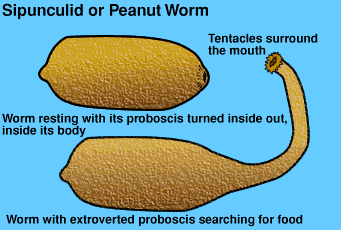
The Peanut worms scientific name is the Sipuncula or Sipunculida. Peanut worms are made up of a phylum of somewhere between 144 and 320 different species. The Peanut Worm has bilateral symmetry and is an unsegmented marine worm.


The Peanut worm is known for its crazy mouth. The worms mouth has anywhere from 18-24 tentacles around it. The worm has a digestive system or tract which starts in the mouth, through the posterior part of the body and working its way towards the anus on the opposite side or dorsal side of the body. It has an anal shield that makes the worms anus "invisible." The worms do not have vascular blood systems, they use something called interstitial fluid. This system transports oxygen and good nutrients around the worms body structure. The worm has a body structure which is very strong. Its muscles dense up when it feels scared or threatened. The reason why it is called a Peanut Worm is because when it retracts its body, it looks like a peanut.


The Peanut worm reproduces both sexually and asexually. More peanut worms can be found to produce sexually. The Peanut worms produce their gametes in the lining of their coelom. They are then put into the coelom to mature. Then they are taken by the metanephridia system and released into an aquatic environment. The male and female gametes come together and develop something called a Trochopore larva. After that a Pelagosphera larva becomes a small worm and then an adult! MAZEL TOV!

Wednesday, March 25, 2009

ONE OLD DUDE!

The fossil fragments found in British Columbia, CA are not 100, not 200, not even 300 million years old. Researches now say that the fragments found are from a preditor that is over 500 million years old. That is 6,000,000,000(billion) months, 26,000,000,000 (billion) weeks, over 182,500,000,000(billion) days, and over 262,800,000,000,000(trillion) minutes. These are some old bones!

Ye Olde' Coral

Oldest Coral Found

Corals found in Deep sea water, about 400 meters off the coast of Hawaii have been found to be much older than scientists once believed. These coral may be the oldest living coral known to man. The deep water Black Coral is over 4,000 years old!

Tank Under Construction


Today in class, we put water in our tanks. The sediment has to settle so the tank will clear up. We will put fish in after spring break!

Wednesday, March 4, 2009

Sergeant Major

My fish!

The Sergeant Major or pintano whose scientific name is Abudefduf saxatilis is a large, colourful damselfish. It earns its name from its brightly striped sides, which are reminiscent of the insignia of a military Sergeant Major. It grows to a length of about 15cm (6 inches).


Friday, February 27, 2009

Hello

This week in class we learned about algae and stuff.....