Friday, February 27, 2009
Friday, February 20, 2009
RED TIDE, blue tide, one tide, two tide!!!!!
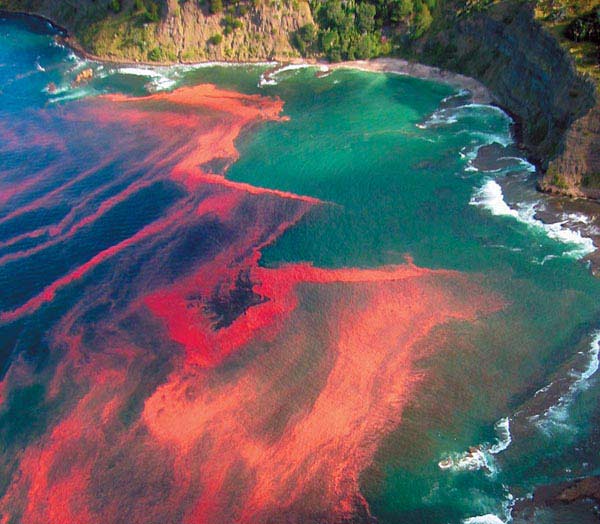
RED TIDES are also known as the Algae Bloom. An Algae Bloom is an event where three types of algae join together rapidly in whats called a water column. Those three are estuarine, marine, or fresh water algae. The algae, or phytoplankton are single-celled protists, that can form together near the surface of the water. Some phytoplankton have pigmants that make them turn a red color. Obviously, when they all come together, it makes the water look red or pink. Also, red tides are do not occur because of the tide movement so they gave it the name algae BLOOM.
Some of the red tides are bad and hurt whats living in the water so those are called Harmful Algae Tides. It has been found to be extremely harmful to marine and wildlife around the areas where Red Tides form. It takes away some of the Nutrients that helps animals live.
Many scientists believe that the first plague in the bible, blood, was actually caused by red tides. The scientists believe that the red tides brought on the second plague, frogs. All of the frogs fled the water because they could not live in the harsh, algae bloom environment.
Wednesday, February 4, 2009
DANK TANK
Wednesday, January 28, 2009
Sea Water
Class Notes for 1-26 and 1-28
- Theory is a well-stated concept that explains a wide range of observations
- It is predictive and testable
- Theory-a broad statement
- Law- more precise and specific
- Ring of fire- Volcanos along border of pacific plate
- Faults- break in the crust where rocks slip past each other
- Divergent Boundary- Two plates pull apart
- African Rift Valley-Plates pulling apart
- Siklet fish lived in lakes on African rift
- Convergent Boundary-Two plates move together
- Transform Boundary- Side by side movement
- States of matter-solid, liquid, gas
- Density=mass/vol.
- Water most dense at 4 degrees Celsius
- Water=best solvent
- Crusts add salts
- Most of ocean 35% salt
- Temp. has effect on salinity
- Density drops as Salinity increases
- Cold water holds more gases
- Deeper light penetration in open waters rather then shallow shores
- Ocean Circulation-Ocean currents move by gravity
- Thermohaline Circulation- cycle of warm and cold water+salinity
Sunday, January 25, 2009
Friday's Class- Jan. 23, 2009
- 71% of the world is Ocean
- World is made up of 4 Basins-Atlantic, Indian, Arctic, and Pacific oceans
- Earth is 4.5 billion years old
- Ocean Crust-Basalt, thin, more dense, oldest rock 200 million years old
- Continental crust-granite, thick, less dense, oldest rock 3.8 billion years old
- Crust-5-7 KM thick
- Mantle-3000 KM thick/Divided into Lithosphere, Asthenosphere and Lower Mantle
- The Core- Made up of iron and nickel/ Divided into Outer and Inner Core
- Radiation-Transfer of Energy through space
- Convection-Heat transfer by movement of liquids
- Convection Current- Flow of heat
- Convection Currents in Earth- Heat in core causes convection in mantle
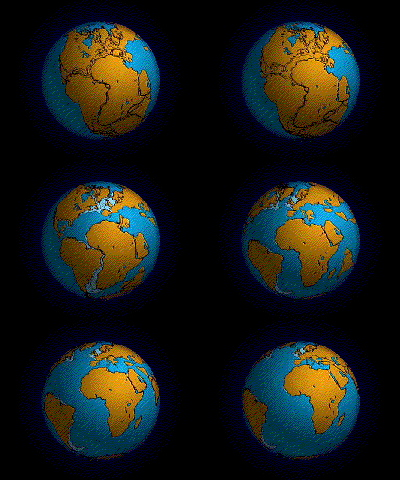
- Evidence of Pangea found in land features, climate and fossils
- Mid oceanic ridges are where the sea floor is spreading apart